
A delinquent borrower disputes a recovery visit: "The agent never came." A KYC visit that was supposed to happen before disbursement can't be evidenced. An audit committee asks for proof that mandated relationship-manager touchpoints actually occurred — and the answer is a spreadsheet somebody typed up three days after the fact.
Every bank running distributed field teams knows this feeling. The work happens far from head office, across hundreds of officers and dozens of branches, and by the time it becomes visible it's already history. You're not managing field operations — you're reconstructing them.
That gap between what happened in the field and what head office can prove is where the money leaks out. And in Bangladesh, it's compounded by a problem most field software quietly ignores: the network isn't always there.
The cost of running blind
The invisibility isn't abstract. It shows up on the P&L in four specific ways.
Field activity is invisible until it's too late. Visit reports arrive days late. Territory coverage gaps go undetected until the quarterly review. Some agents post eight visits a day, others post two — and managers can't tell who, where, or why, so there's no way to intervene in real time.
There's no verifiable evidence of contact. This is the expensive one. When a recovery visit is disputed, when a KYC site check is questioned, when an audit asks for proof — a paper trail that can be lost or fabricated isn't evidence. It's a story.
Productivity leaks quietly. Route inefficiency and low performers hide in the aggregate. Without visibility into individual and territory-level activity, the leaks stay invisible until they're structural.
Regulatory pressure keeps rising. Bangladesh Bank's ICT guidelines, internal audit, and external audit increasingly expect tamper-evident logs of customer-facing field activity. Excel-based tracking is no longer a defensible answer to a regulator.
Put together, the cost is leaked productivity, weakened collections, avoidable audit findings, and customer disputes that should never have been disputable in the first place.
The obvious fix that quietly fails here
The instinct is straightforward: give every field officer an app that logs their location and their visits. Problem solved.
Except it isn't — not in Bangladesh. Any field platform built for markets with reliable connectivity makes one fatal assumption: the device is online when the work happens. Drop that assumption and the whole model collapses.
Field officers work in exactly the places where cell coverage thins out or disappears — rural agent-banking points, industrial areas, the far edges of a territory. A tracking app that needs a live connection to record a visit will simply lose the visit. Worse, it will lose it silently, and the officer won't know until they're back at a desk trying to explain a gap.
So the real engineering requirement isn't "track location." It's capture everything reliably, offline, and reconcile it faithfully when the network returns — without draining the battery, without losing a single record, and without letting anyone quietly edit history in the meantime.
That means:
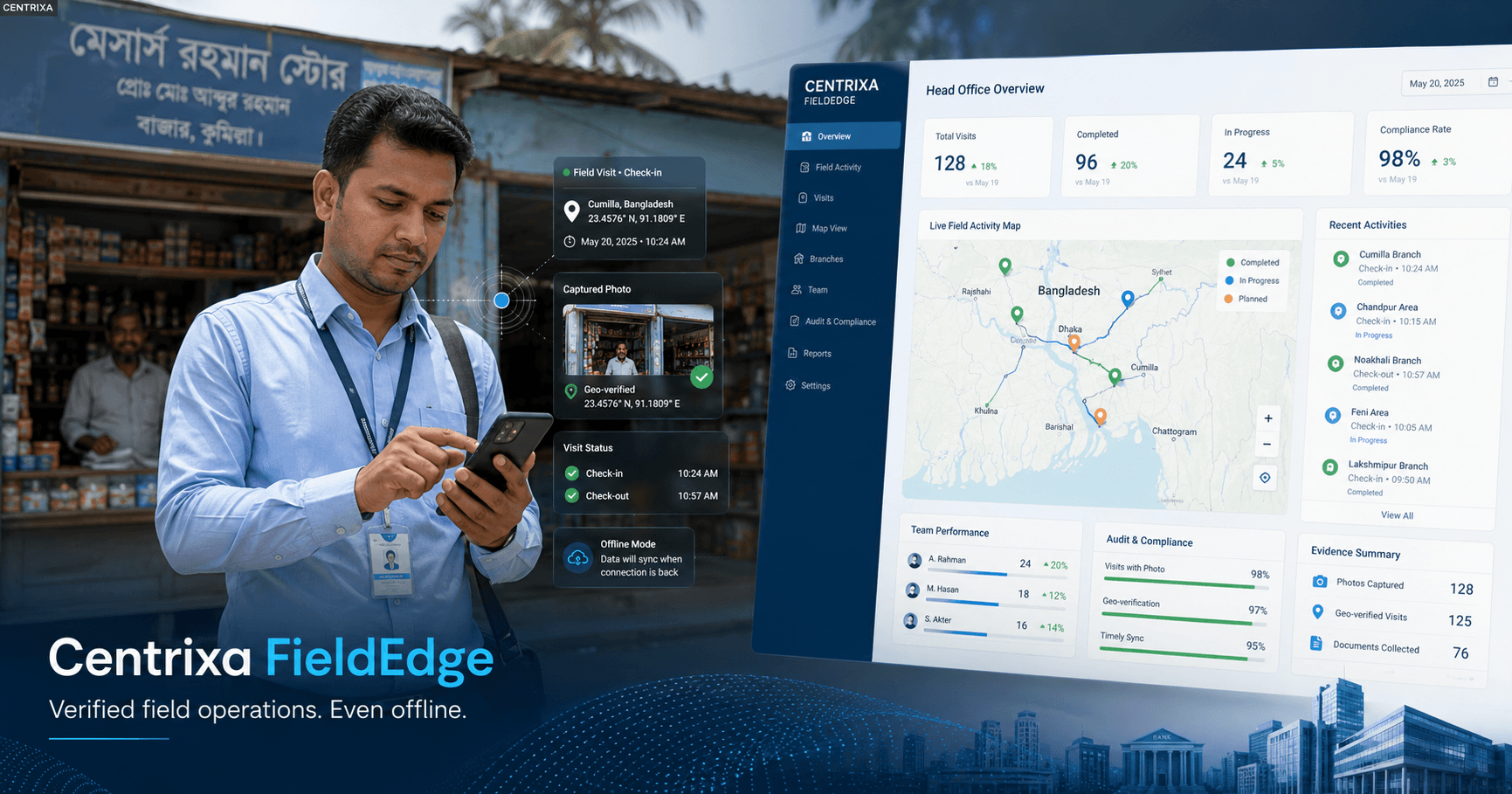
- Offline-first by design, not as a fallback. GPS capture, visit logging, and photo evidence all have to work with no connection at all. The data is buffered on the device and synced automatically when connectivity returns.
- Battery-efficient background tracking. Continuous location awareness is worthless if it kills the phone by noon. Ping frequency has to be configurable and the background service has to be light.
- Faithful reconciliation. When a device comes back online after hours offline, the sync has to preserve the original timestamps and locations — not stamp everything with the moment of upload. A visit that happened at 11:04 AM in a dead zone has to remain a visit that happened at 11:04 AM.
This is unglamorous engineering, and it's exactly the part that separates a field platform that works in Bangladesh conditions from one that demos well in a boardroom and falls apart in the field. Offline capability here isn't a feature bullet. It's the difference between a system of record and a system of gaps.
Verification is the actual product
Once you can capture reliably, the question becomes: how good is the evidence?
A GPS coordinate alone can be spoofed or explained away. What turns a logged visit into something that holds up in a dispute is the combination:
- GPS-stamped check-in and check-out, so there's a location and a time bracket, not just a claim.
- Photo evidence with the location burned into the image itself — tamper-evident geo-stamping, so the photo can't be quietly swapped or backdated.
- A structured record with the fields that matter for that workflow, whether it's a recovery attempt, a pre-disbursement KYC check, or a branch audit.
The shift this creates is subtle but decisive. "The agent never came" stops being a he-said-she-said and becomes "here is the photo, the GPS coordinate, and the timestamp." Court-grade evidence of contact. The dispute doesn't get argued — it gets closed.
Why the security team signs off
None of this matters to a bank if the platform itself is a risk. Field verification data is sensitive: customer locations, officer movements, photographic evidence tied to lending decisions. A bank's IT security and risk committee will — correctly — treat the platform as part of their attack surface.
So the security posture has to be built for that scrutiny, not bolted on:
- Encryption in transit and at rest. TLS 1.2+ for all mobile, web, and API traffic; data, photos, and attachments encrypted on the backend.
- Role-based access control. Officers see only the data within their own territory, team, and hierarchy. Head office sees the unified view. Nobody sees more than their role permits.
- Device binding and remote revocation. Mobile devices are bound to specific users; a lost or compromised device can be revoked centrally.
- Immutable audit logs. Admin actions, data changes, and access events are logged and can't be quietly rewritten — which is precisely what turns "we track visits" into "we can prove what happened, and prove that the proof wasn't tampered with."
- Deployment that fits the bank's posture. Managed cloud, a dedicated isolated tenant, or full on-premise deployment inside the bank's own infrastructure — so data residency and sovereignty requirements are a configuration choice, not a dealbreaker.
Underneath it, the engineering is delivered under ISO/IEC 27001:2022 and ISO 9001:2015 certified processes — which means the controls an audit committee asks about (access control, cryptography, backup and recovery, change management, incident response) map to a framework they already recognize, rather than a vendor's promise.
The point
Field operations don't have to run in the dark, and "the agent never came" doesn't have to be a defensible claim. The technology to make every field visit verified, visible, and auditable exists — and, critically, it works in the network conditions Bangladesh field teams actually operate in.
We know this because we built it, and it's live in production at a leading Bangladesh NBFI today: Centrixa FieldEdge, our field-force management platform. Offline-capable mobile for the field, live dashboards for head office, tamper-evident records for audit — one platform, engineered to the same ISO-audited standard as the rest of what we ship.
If your field operations still depend on trust that can't be verified, that's a solved problem now. We're happy to walk your IT and risk team through exactly how it holds up.