
Challenge
The beverage distribution industry operates across a fragmented ecosystem of suppliers, distributors, and retailers — each with different priorities, data needs, and operational workflows.
Suppliers needed visibility into brand-level sales performance across accounts. Distributors needed to manage territories, track accounts receivable, and coordinate sales reps. Retailers needed access to their own account data, buyer contacts, and order history.
Existing tools were disconnected: spreadsheets for sales tracking, email chains for visit recaps, paper-based route planning, and phone calls for inventory checks. There was no unified platform where all three parties could collaborate, share real-time data, and operate from a single source of truth — leading to missed opportunities, duplicate efforts, and slow decision-making across the supply chain.
The solution needed to be available as a native mobile app on both iOS and Android (Google Play Store and Apple App Store), with enterprise-grade security for sensitive pricing and financial data.
Approach
Periscope Labs designed and built Orange Peel — an end-to-end mobile CRM platform from the ground up — a single application serving three distinct user roles (Supplier, Distributor, Retailer) with tailored views, permissions, and data scope controlled by a granular RBAC engine.
Orange Peel is available on both the Google Play Store and Apple App Store.
The app was built with Ionic and Vue.js for cross-platform deployment on iOS and Android from a single codebase. The backend uses MySQL with carefully designed multi-tenant data isolation, hosted on AWS infrastructure for scalability and reliability. Sensitive data — including supplier pricing, account financials, and A/R aging — is encrypted at rest using AWS KMS, while Amazon S3 handles storage for shelf audit photos, display evidence, document uploads, and report exports.
Each role sees only the data relevant to their scope — suppliers see their brands across assigned accounts, distributors see territory-wide performance across all suppliers, and retailers see their own account profiles and sales history.
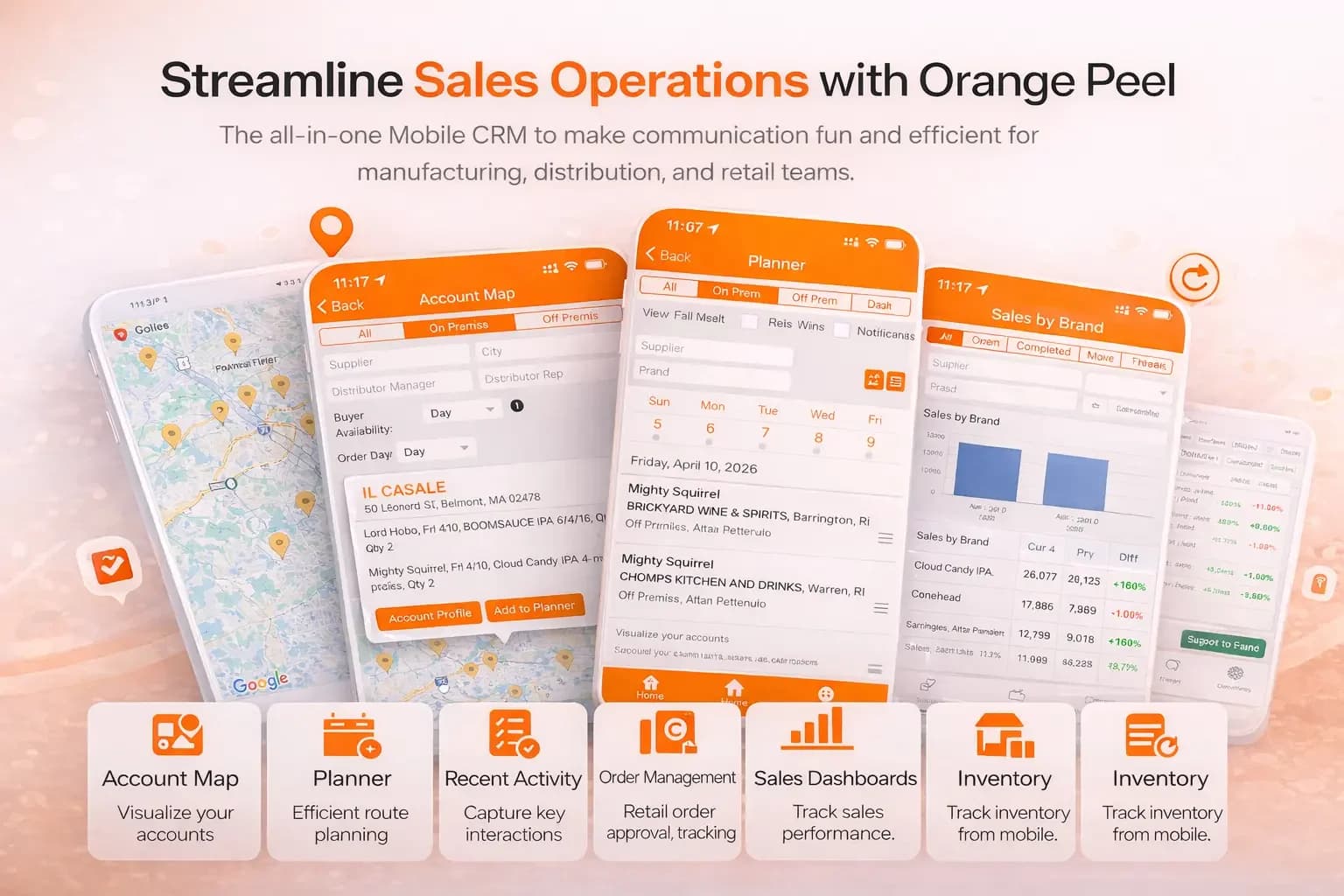
Key modules include: Sales Intelligence with CEs, units, dollar values, and YoY trend analysis; a Weekly Planner with calendar-based scheduling for visits, tastings, and ride-withs; an Activity Feed capturing detailed visit recaps and meeting notes; real-time Inventory Tracking with available/committed/allocated quantities; A/R Aging reports for distributors; Account Profiles with buyer contacts and channel classification; and an interactive Account Map powered by Google Maps API for route planning and geo-based account discovery.
OneSignal was integrated for push notifications — order updates, planner reminders, and real-time collaboration alerts. The platform also supports photo uploads for shelf audits and display evidence (stored on S3), Excel export for custom reporting, and on-premise/off-premise channel filtering across all modules.
Outcome
Orange Peel is now actively used by 40+ suppliers and their distribution partners across North America, serving as the central collaboration hub connecting all three parties in the beverage supply chain.
The app is publicly available on both the Google Play Store and Apple App Store.
Suppliers report significantly improved visibility into brand performance with real-time sales analytics and YoY comparisons that previously required manual spreadsheet compilation. Visit planning efficiency improved dramatically with the integrated planner and Google Maps route optimization replacing ad-hoc scheduling. The activity recap system eliminated email-based reporting, giving all stakeholders instant access to visit notes, tasting feedback, and meeting outcomes.
Distributors benefit from unified A/R aging visibility, territory management, and cross-supplier inventory views — reducing collections cycles and improving rep coordination. Retailers gained self-service access to their account data, eliminating phone calls for basic sales and inventory inquiries.
The AWS-hosted infrastructure ensures high availability and scalability as new suppliers onboard, while KMS encryption provides enterprise-grade security for sensitive financial data. The RBAC architecture proved highly scalable — onboarding new suppliers requires only role configuration, not code changes, enabling rapid platform growth without engineering overhead.